
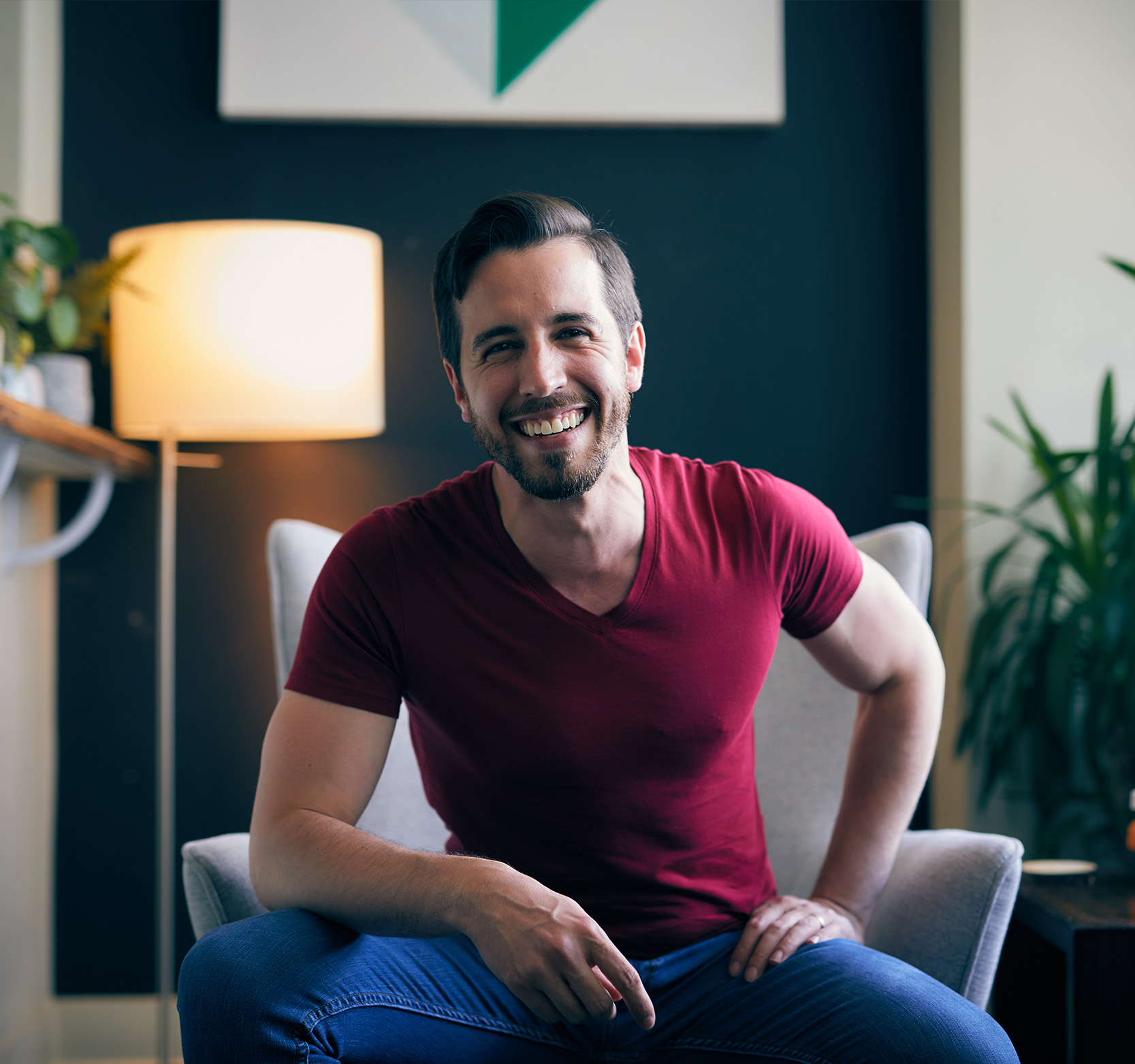
As a journalist and mental health advocate, author, and speaker, Mark Henick’s career sits at the intersection of health and science, social policy, and lived experience—something his liberal arts background prepared him to navigate.
“A liberal arts education helps you understand people, power, culture, and context. In a world that changes constantly, that ability to think critically and empathetically is far more durable than any single technical skill,” Henick said.
Versatile and Fulfilling Career—Senior Writer and Breaking News Producer, CBC, and Best-Selling Author
Henick currently works as a senior writer and breaking news producer with CBC News Network. He was also the public broadcaster’s first nationally syndicated weekly mental health radio columnist, which allowed him to host more than a thousand local conversations about wellbeing in nearly every market across Canada.
Henick is also the best-selling author of So-Called Normal: A Memoir of Family, Depression and Resilience, and the founder of an independent mental health media consulting practice. His TEDx Talk “Why we need to talk about suicide” is among the most watched with millions of views. The STU alumnus says the common thread that ties all of his diverse work together has always been his passion for storytelling.
“I’ve come to see myself as a sort of interpreter. I try to distill confusion into understanding. A big part of my work is helping systems to remember the people they’re meant to serve and helping people to remember that they need to be active participants in the systems that shape their lives,” Henick said.
His time at STU, the interdisciplinary nature of his studies—he honoured in Interdisciplinary Studies and majored in Psychology and Philosophy—and the development of critical thinking, clear writing, and communication skills provided him with the foundation for a versatile and fulfilling career.
Most important to Henick was the development of what he calls “empathy sharpened by analysis.”
“STU taught me that compassion and rigour aren’t opposites; they’re partners,” he said. “To exist in and move through this world with both a mind and a heart—to keep both open, especially when it’s hard. If I accomplish nothing else through my work and my life, I hope it’s that.”
“STU was a turning point and an important chapter in my life”
Henick came to STU from Cape Breton, NS, and was the first and only one in his immediate family to attend university. Looking back, he can see how this decision changed his trajectory.
“I struggled through junior high and high school due to my repeated and extended mental health-related hospitalizations and absences. My grades improved by the time I graduated, but I still didn’t think I was good enough,” Henick said.
“The writer of my STU acceptance letter congratulated me on a strong grade in political science. I remember feeling so encouraged that someone chose to see and reinforce a strength rather than one of my many failings for a change.”
What Henick found at STU was a community—inside and outside of the classroom—that encouraged him to ask questions, take on challenges within a safe, supportive environment, and grow intellectually and personally.
“STU was a turning point and an important chapter in my life. Not because it fixed any of the things I thought were wrong with me, but because it gave me the space, the right challenges, and the fuel I needed to grow. I still carry that with me,” he said.
As a student, Henick thrived. He was involved with residence life, sat on the Senate and Board of Governors, and served as Vice-President and later President of the Students’ Union.
His advice to future students: it’s okay if you don’t know where you’re going yet.
“My career has never followed a straight line, and I hope it never does. And STU gave me the confidence to navigate that. A good liberal arts education is so valuable because it doesn’t teach you what to think, but rather how to think,” he said.
“Take your education seriously, but don’t confuse your grades with your worth. Build relationships. Say yes to conversations that make you uncomfortable. Savour and celebrate the experience, because this moment in your life only happens once, but it’ll stay with you forever.”
/filters:format(webp)/prod01/stuca/media/stu/site-assets/images/features/Brennan-Lowrey-OpEd.jpg)
/filters:format(webp)/prod01/stuca/media/stu/site-assets/images/features/STU-Cares-2026.jpg)
/filters:format(webp)/prod01/stuca/media/stu/site-assets/images/features/Doug-Dolan-News-Item.jpg)